
We are starting a series of blog content focusing on the current state of the global economy. The guest writer for Jalonomi's blog isTuomas Malinen, from the analysis and forecasting agency GnS Economics , chief economist and CEO, as well as a docent of economics at the University of Helsinki.
The global economy is facing multiple threats simultaneously. The U.S. financial market has been on life support since last September, economic growth in the euro area has slowed dangerously, and since the beginning of this year, the coronavirus has emerged as a threat to both the global economy and people's health.
The global economy has been stimulated by China and central banks since 2009. Never before has the economy been stimulated throughout an entire expansion period. This has made the global economy fragile.
Q-Review 4/2019. -report discusses why the global economy is likely to plunge into a new economic crisis this year and how the crisis will unfold. The presumably severe economic impacts of the coronavirus will accelerate the onset of the crisis, but its roots are deep within the structures of our economy. The entire fragile structure began to crumble back in September 2019.
The repo market is collapsing
The U.S. Federal Reserve saved the financial markets from collapse by making a complete turnaround in its monetary policy at the beginning of January 2019. The peace achieved by this very unusual "U-turn" was suddenly shattered on September 16, when the rates on repurchase agreements, or the so-called repo market, surged suddenly by 248 basis points, more than double the Fed's overnight deposit rate.
As a result of this "spike," the repo market, worth over four trillion dollars, fell into immediate panic. The problem was serious because large institutional investors use repos to meet short-term, usually daily, financing needs. If repo market rates rise too high, highly leveraged financial market institutions begin to collapse, as the cost (interest) of their short-term financing rises significantly above the yield from long-term loans. This would have serious implications for the financial markets.
The Fed acted quickly and halted its reverse repo operations, which were used to withdraw liquidity from the financial markets. It initiated massive repo operations, offering tens of billions in short-term loans to large banks and financial institutions operating in the repo market. Additionally, in October, the Fed began purchasing short-term U.S. federal debt with maturities of less than one year in an operation it called "Not QE."
The repo issues are underpinned by central bank emergency programs and changes brought about by the 2008 financial crisis. For example, the interbank lending market has never recovered from the financial crisis. Today, banks require collateral for loans granted there, which has shrunk the market to a very small size. According to a report published by the Bank for International Settlements (BIS) in December, the four largest banks in the United States have become the primary lenders in the repo market over the past two years. Over the years, banks have increased their holdings of U.S. Treasury securities, which has reduced their available reserves, or cash, that they lent out in the repo market. According to BIS report , the four largest banks in the United States have become the primary lenders in the repo market over the past two years. Over the years, these banks have increased their holdings of U.S. government securities, which has reduced their available reserves, or cash, that they lend out in the repo market.
The background of this development seems to have been particularly the securities purchase programs of central banks. The so-calledQEprograms accustomed banks to large amounts of central bank reserves that offered a secure interest return.
When the central bank's balance sheet reduction program (QT) began to shrink banks' reserves, they replaced them with another safe source of return, namely U.S. federal government bonds. These provided safe returns, especially from riskier loans and risky securities, which the QE programs had driven banks to increase. Protecting against risky loans and investments is particularly important when an impending economic recession threatens their returns. In 2019, the first warnings of a recession were received.
According to the BIS report , these exceptional programs of central banks also reduced banks' activity in financial markets. These developments led to the likelihood that large U.S. banks have become very cautious about participating in the repo market if there is even a small threat of loss on the borrowed funds.
The increased leverage poses a threat to the stability of financial markets
However, behind the problems in the repo market lies another, more concerning development: the rise of hedge funds as significant users of the repo market. They seek short-term financing from the market, which they use to acquire eligible securities (mainly short-term U.S. federal debt) that they lend back to the repo market to obtain more short-term financing. With such a "debt loop," they are able to significantly increase their leverage.
This is a direct result of central banks' asset purchase programs and zero interest rate policies. When financial market institutions are unable to obtain sufficient returns from securities, whose interest rates have fallen to extremely low levels due to central bank programs (see more in Q-Review 1/2018), they are forced to resort to large-scale use of leverage.
We have been warning about this for years (see, for example, Q-Review 4/2013). Such massive use of leverage speaks volumes about the negative effects of central banks' low interest rates and asset purchase programs.
There is too much debt in the world
According to the Institute of International Finance, global debt has risen to over 320 percent of the world's gross domestic product. An exceptionally large portion of this debt is owed by governments and corporations.
The International Monetary Fund, IMF, recently warned, that in a recession, the amount of corporate debt at risk of insolvency could rise to $19 trillion in the eight largest economies. When this is compared to the world's gross domestic product, which was estimated to be about $86 trillion in 2019, the figure is significantly high. For example, U.S. corporate debt relative to GDP is at a record high (see Figure 1).
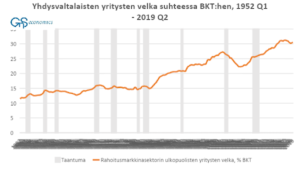
Figure 1. Debt of U.S. non-financial corporations relative to U.S. gross domestic product. Source: GnS Economics, St. Louis Fed
Central banks have supported the financial markets
Central banks have been supporting financial markets for years, but ultimately the real economy determines their direction. This is, for example, the key lesson from the great stock market crash of 1929. The great stock market crash. Although cheap money can support the markets longer than the developments in the real economy would suggest, it only exacerbates their inevitable correction.
Since September 2019, the Fed and major central banks have been trying to prevent a collapse of the financial markets by massively increasing their balance sheets (see Figure 2). Desperation is understandable, as the impending collapse of the financial markets threatens not only the global economy but also the existence of central banks (see more in Q-Review 3/2019.).
However, central banks are fighting a lost war. A crisis is coming.
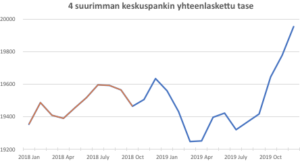
Figure 2. The combined balance sheet of the central banks of Europe, Japan, China, and the United States from January 2018 to December 2019. Source: GnS Economics, Fed, ECB, BoJ, PBoC.
Recession and crisis are approaching
A new economic crisis is likely to begin with serious problems in the capital markets and/or the European banking sector.
The latest stress test of the European Central Bank (ECB) showed that half of the European banks would not survive if their financial market counterparties and some corporate clients withdrew their money from the banks. This is exactly what happens in a recession (see more in bank stress test indicated that half of Europe's banks would not survive if their financial market counterparties and some corporate clients withdrew their funds from the banks. This is exactly what happens in a recession (see more details Q-Review 4/2019.).
The coronavirus has forced China into extreme emergency measures. China has closed factories, placed over a hundred million people in quarantine, and restricted travel. Since the European economy is extremely dependent on the pull of the Chinese economy and the demand it creates, the coronavirus is likely to push Europe into recession during the spring.
As Europe sinks into recession, our banks' problems will resurface. Since Europe has the largest concentration of so-called systemically important banks, our banks' issues will spread to the world very quickly.
This means that a new global economic crisis could start as early as summer. It is advisable to begin preparations at the latest now.
Advice on preparedness is available Crisis preparedness in our reports. In addition, we are closely monitoring the progress of the crisis in our Deprcon economic service as well as in our Q-Review reports. In the next Q-Review report to be published in early March, we will focus on the economic impacts of the coronavirus. Q-Review In the report, we focus on the economic impacts of the coronavirus..
Tuomas Malinen,
chief economist
GnS Economics CEO
docent of economics at the University of Helsinki