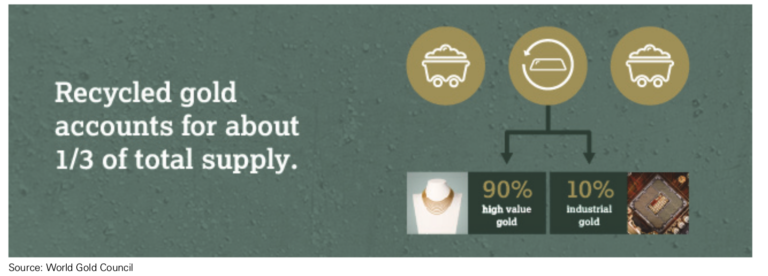
Recycled gold is an important part of the market, accounting for about 30% of production annually over the last 20 years.
Although mined gold reserves are about 190,000 tons, a very small portion of that is recycled. The highest share of recycled gold was in 2009, when it accounted for about 1% of all the gold on Earth. But it is still a significant part of the market, covering about 30% of production over the last 20 years.
The amount of recycled gold varies with the price of gold and economic conditions. Price changes account for about 75% of the annual changes in the amount of recycled gold, and economic crises, such as the Asian financial crisis in 1997, can increase the popularity of recycling.
Gold recycling consists of two different segments. The share of jewelry in the total supply of recycled gold is about 90%, and 10% comes from industrial recycling. The value chains for jewelry and industrial recycling are very different.
Gold reserves
Gold is adaptable and corrosion-resistant and has several uses. It is used in jewelry, investment products, and electronics, such as mobile phones and spacecraft safety equipment. Current best estimates suggest that throughout history, about 190,040 tons of gold have been mined. Since gold is indestructible, nearly all of this metal is still in use in one form or another.
Although theoretically all mined gold reserves could be recycled, only a small portion of it is available for recycling.
Most of the gold that has been recycled once is unlikely to re-enter the market for many reasons. Many people have gold in the form of jewelry that has sentimental value, such as engagement rings and heirlooms. For others, the connection to gold is through religion; for example, in India, gold is kept in temples and is considered sacred. Meanwhile, many investors see gold as a generational asset that is passed down to children rather than sold. Some do not realize the value of gold in their electronic devices and throw away old phones and computers. A large portion of the gold used in technology from 1980 to 1990 is likely in landfills.
Economic factors in recycling
By recycled gold, we mean gold that has been exchanged for cash by consumers or other actors, such as jewelry manufacturers selling off old inventories or processing waste. This does not include the exchange of gold, meaning trading old jewelry for new or for a gift card at a jeweler.
The amount of recycled gold varies as the price of gold and economic conditions change. This helps keep the global gold market balanced.
The three key themes of gold recycling are;
- The amount of recycled gold grows slowly over time, along with the amount of jewelry.
- Economic crises increase recycling. During financial crises, people turn to gold for security, as it is a liquid investment.
- Changes in the price of gold have a significant impact on the amount of recycled gold.
Recycling of Jewelry vs. Investment Products
Gold is primarily recycled in the form of jewelry. Gold bars and coins are generally not recycled but are sold instead. Unlike gold jewelry, which may go out of style or become damaged, even old gold bars and coins retain their market value.
The high gold content of gold bars and coins remains constant regardless of age, making them easily priced based on the global market price of gold. Therefore, the age of investment gold products does not affect their characteristics as an investment, and for this reason, they are more often resold than recycled.
Recycling process
The gold recycling sector can be divided into two different markets. Jewelry, which accounts for about 90% of the total supply of recycled gold, and industrial recycled gold, which accounts for the remaining 10%.
How does it work? Gold jewelrycontains not only gold but also other metals, making the jewelry durable for use. Separating these metals from each other is relatively simple, and the processes used by refiners are either chemical or physical separation methods. Some separate the metals by heating and melting the mixture, but often this procedure is not sufficient to refine higher concentrations. To achieve this, more complex methods have been developed, which often rely on chemical reactions. For example, refiners may use aqua regia process to separate the mixture in strong acids before gold is recovered electrolytically. This allows for the removal of all other metals from the mixture, resulting in very pure gold.
How does it work? Industrial recycling.Gold in the electronics industry (mainly in the form of thin wires and coatings) has created the concept of "urban mining."
Urban mining can contain 60 different elements, including numerous complex and sometimes even hazardous chemicals. In industrial recycling, plastics and steel are the largest in quantity, but in value, gold and other precious metals still dominate. The separation of precious metals from these materials is safe and efficient. Some companies have developed processes for recovering precious metals using the latest technology. For example, at Umicore's plant in Hoboken, Belgium, 17 different metals are collected from various waste streams (such as used catalysts and chemical catalysts, industrial materials, and various manufacturing waste). The facility uses a closed-loop process where almost nothing is wasted. Even slag is used as a building material, and sulfuric acid is recovered and utilized.
Not all recycling facilities operate at such a high level.
The United Nations Environment Programme estimates that only 15-20% of electrical and electronic equipment is recycled, with the rest going directly to landfills and waste incineration plants.
The attractiveness of urban mines has led to unregulated collection of metals from electrical and electronic devices. The separation of metals using chemicals, such as cyanide and aqua regia, sometimes occurs even without proper protection, especially in developing countries.
Several agencies and companies are working to address issues related to the recycling of electronic waste. For example, WorldLoop collaborates with recycling companies to train entrepreneurs in Africa to create environmentally friendly solutions. Thanks to these partnerships, African countries now have sustainable recycling operations.
Industrial structure
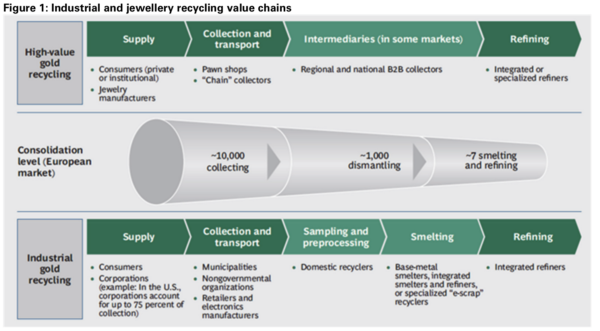
The value chains of industrial gold and jewelry value chains are different. The value chain for industrial gold recycling is longer, involves more players, and is more complex than the value chain for recycling gold jewelry. These differences arise from additional steps such as dismantling, pre-processing, and melting, as well as more advanced technology required for recycling industrial gold.
The recycling of gold jewelry and industrial gold also differs in market structure.
Jewelry recycling services are generally local. For example, Umicore has six recycling facilities around the world, while other refineries focus on a single region, such as the Canadian Mint, Ohio Precious Metals in North America, Tanaka and the Perth Mint in Asia, and Rand in Africa.
The industrial gold markets serve globally, and pre-processed material is delivered to individual smelting and refining facilities. This is due to the locations and complex equipment required for industrial recycling, so recyclers consolidate their operations in one place to serve global markets.